Studying abroad means completing a degree or postgraduate qualification at a foreign university. For Indian students, this typically involves choosing a destination country, meeting that country’s academic and language requirements, clearing standardised tests, and securing a student visa. It is not a single career path — it is a mode of education that cuts across engineering, medicine, management, sciences, and humanities.
This page helps you understand the full landscape: which study-abroad options exist for Indian students, what each one costs and demands, which exams you need, and how to honestly assess whether going abroad is the right move for you — or whether a strong Indian institution might serve you better.
Use this page to compare the six main pathways. Each pathway has its own detailed guide (linked by the system below) with step-by-step instructions on applications, finances, and post-study work rights.
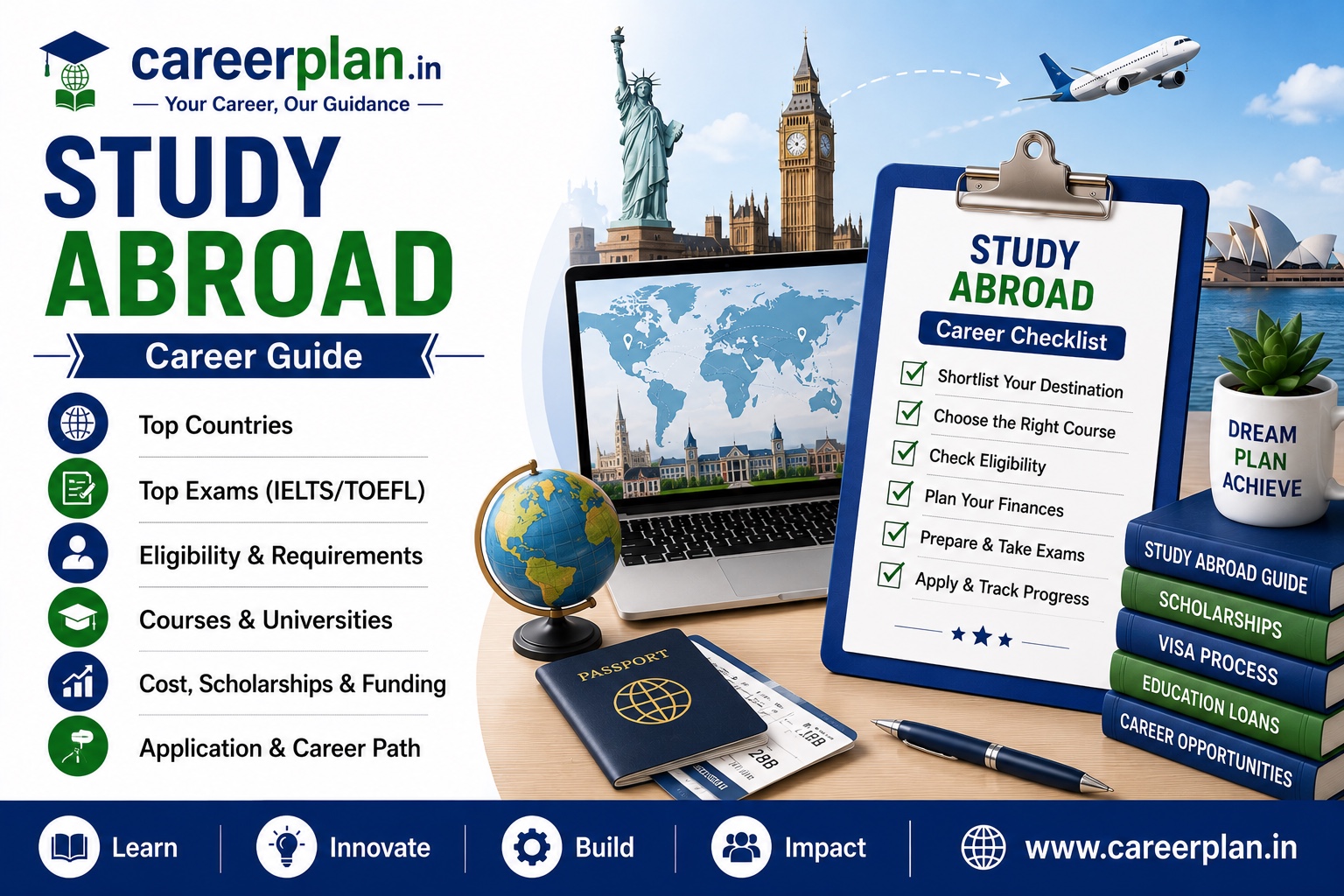
All Study Abroad career guides
What Does 'Study Abroad' Cover?
Study abroad, for Indian students, broadly refers to enrolling in a degree-granting foreign institution — at undergraduate (UG), postgraduate (PG), or doctoral level — with the intention of completing the qualification there. It is different from short exchange programmes or online courses.
The field spans several distinct goals:
- Academic and research advancement — pursuing an MS or PhD at a university ranked highly in a specific discipline.
- Professional qualification — an MBA at a globally recognised business school to shift careers or industries.
- Medical training at lower cost — completing an MBBS at a foreign medical university when Indian seats are unavailable or unaffordable, subject to licensing on return.
- Immigration pathways — choosing countries like Canada where a student visa can transition into permanent residency.
- Domain-specific ecosystems — studying engineering in Germany or finance in the US to access industry clusters, research labs, and alumni networks that are not yet matched in India.
The key decision variables are: destination country, level of study (UG vs PG), field of study, cost vs funding availability, and post-study intentions (return to India, work abroad, or migrate). None of these decisions should be made independently of the others.
Pathways Within Study Abroad: Your Options at a Glance
The table below summarises the six main study-abroad pathways covered on this site. Each row corresponds to a detailed spoke guide. Entry routes and outcomes differ significantly — read the relevant guide before deciding.
| Pathway | Level | Primary Destination(s) | Key Entry Tests | What It Typically Leads To |
|---|---|---|---|---|
| MS Abroad (GRE) | Postgraduate | USA, Germany, Canada (and others) | GRE, TOEFL/IELTS | Specialised master’s in STEM, social sciences, or humanities; research roles, industry jobs, or PhD |
| MS in USA | Postgraduate | United States | GRE, TOEFL | STEM OPT extension (up to 3 years work authorisation), tech/research jobs in the US or return to India |
| Masters in Germany | Postgraduate | Germany | GRE (some programmes), IELTS/TestDaF, APS certificate | Low or no tuition fees at public universities; work in Germany’s engineering and manufacturing sector or return |
| Study in Canada | UG and PG | Canada | IELTS/TOEFL; GRE/GMAT for PG | Post-Graduation Work Permit (PGWP), potential PR via Express Entry or Provincial Nominee Programme |
| MBA Abroad (GMAT) | Postgraduate | USA, UK, Europe, Singapore, Canada | GMAT (or GRE accepted by many), TOEFL/IELTS | Senior management roles, career pivots, global business networks; high upfront cost |
| MBBS Abroad | Undergraduate (medicine) | Russia, Ukraine, China, Philippines, Bangladesh, others | NEET-UG (mandatory for Indian students), university admission test | Foreign MBBS degree; must clear FMGE or NExT to practise in India; or pursue further training abroad |
Is Study Abroad the Right Choice for You?
Studying abroad is not automatically better than studying in India. The decision depends on specific circumstances. Below is an honest assessment of who benefits and who may not.
Likely a good fit if you:
- Have a clear academic or career goal that a specific foreign institution or country serves better than available Indian options — for example, PhD research in a niche field, or an MBA at a top-ranked school not present in India.
- Can demonstrate genuine financial planning — either personal funds, scholarships, or a credible loan strategy — without taking on unmanageable debt relative to expected earnings.
- Are comfortable with significant adjustment: living independently abroad, navigating visa systems, building social networks from scratch, and managing finances in a foreign currency.
- Have academic credentials (grades, GRE/GMAT scores, English proficiency) that make you competitive for admission and funding.
- Intend to work abroad for several years, or want specific global exposure for a career that values it.
May not be the right move if you:
- Are choosing a foreign university primarily because you did not get into a preferred Indian college, without researching whether the foreign institution is genuinely stronger for your field.
- Have not accounted for total cost including living expenses, health insurance, and return travel — foreign education loans carry real repayment obligations.
- Expect that any foreign degree guarantees a job or immigration status — work permits and PR are subject to policy changes that can shift year to year.
- Are planning MBBS abroad mainly to avoid NEET preparation — you will still need to clear FMGE or NExT to practise in India, and pass rates for FMGE have historically been low.
- Have strong options at IITs, NITs, AIIMS, IIMs, or reputed central universities — for many roles in India, a strong domestic degree is valued comparably or more than a mid-tier foreign one.
How to Enter a Study-Abroad Path After Class 10 or 12
The right moment to start planning depends on the level of study you are targeting.
After Class 10 (Planning Stage)
Class 10 itself does not determine your study-abroad options, but it shapes them. Choosing Science (PCM or PCB) in Class 11–12 keeps the widest range of options open — engineering, medicine, and science-based master’s abroad. Commerce is appropriate if an MBA or finance-related degree is the goal. Humanities is fine for social sciences, law, or arts-based programmes abroad, though competition for scholarships is different.
After Class 12 (Undergraduate Abroad)
- For UG study in Canada or the US: You need Class 12 marks, IELTS or TOEFL, and sometimes SAT. Apply in Class 12 (October–January for September intake).
- For MBBS abroad: You must clear NEET-UG first — this is a National Medical Commission (NMC) requirement for Indian students who wish to practise in India after foreign MBBS. PCB in Class 11–12 is mandatory.
After a Bachelor’s Degree (Postgraduate Abroad — the most common route)
- MS programmes: A relevant bachelor’s degree (engineering, sciences, etc.) with a strong GPA, GRE score, TOEFL/IELTS, and letters of recommendation. Germany also requires the APS certificate (academic credential verification).
- MBA abroad: A bachelor’s degree plus typically 2–5 years of work experience (for most top programmes), GMAT score, and TOEFL/IELTS.
- Canada PG: Relevant bachelor’s, IELTS/TOEFL, and some programmes require GRE or GMAT.
Start standardised test preparation at least 6–12 months before application deadlines. Most PG applications for a September start are due between October and January of the preceding year.
Major Entrance and Language Tests for Study Abroad
Unlike Indian entrance exams, study-abroad tests are conducted by private organisations and can be taken multiple times. The table below covers the main exams. Check individual spoke guides for score requirements at specific institutions.
| Test | Conducted By | What It Is Used For | Format / Duration |
|---|---|---|---|
| GRE General Test | ETS (Educational Testing Service), USA | MS admissions in USA, Canada, Germany, and other countries; some MBA programmes | Computer-based; Verbal, Quantitative, Analytical Writing; approx. 1 hr 58 min |
| GMAT | GMAC (Graduate Management Admission Council) | MBA programmes worldwide; some MS in management/finance | Computer-adaptive; Quantitative, Verbal, Data Insights; approx. 2 hrs 15 min |
| TOEFL iBT | ETS (Educational Testing Service), USA | English proficiency for US, Canada, and many other countries | Internet-based; Reading, Listening, Speaking, Writing; approx. 2 hrs |
| IELTS Academic | British Council / IDP / Cambridge (joint) | English proficiency for UK, Canada, Australia, Germany, and many others | Paper or computer-based; 4 skills; approx. 2 hrs 45 min |
| NEET-UG | National Testing Agency (NTA), India | Mandatory for Indian students seeking MBBS abroad who intend to practise in India | Pen-and-paper; Physics, Chemistry, Biology; 3 hrs 20 min |
| TestDaF / DSH | TestDaF Institut / individual German universities | German language proficiency for programmes taught in German at German universities | Written and oral; varies by test |
| SAT | College Board, USA | UG admissions at US universities; some Canadian and other UG programmes | Digital; Reading/Writing and Math; approx. 2 hrs 14 min |
Note: Many German public university master’s programmes taught in English do not require TestDaF/DSH. Check individual programme requirements. GRE is not universally required in Germany but strengthens applications.
Where to Study: Types of Institutions to Consider
There is no universal ranking that applies across all fields and all student goals. Instead, consider institution categories and evaluate them against your specific programme and needs.
United States
US universities range from Ivy League and R1 research universities (high selectivity, strong funding for PhD, competitive for master’s) to state universities (broader access, large Indian student communities, varying programme quality) to smaller private colleges. For STEM master’s, research output and industry partnerships in your city matter as much as the university name. Look at placement records for your specific department, not the university overall.
Germany
Public universities (Technische Universitäten, research universities) charge minimal semester fees and no tuition for most programmes. Quality is high in engineering, sciences, and applied research. Teaching language varies — many master’s programmes are in English, but some are in German. The APS certificate is required for all Indian applicants.
Canada
U15 universities (a group of major research universities) are generally stronger for research and PG degrees. Colleges and polytechnics offer diploma and certificate programmes with shorter durations and are popular for those targeting the Post-Graduation Work Permit (PGWP). Location within Canada matters significantly for job markets and PR pathways.
Business Schools (MBA)
Globally, MBA programmes are often discussed in tiers. The Financial Times, QS, and Bloomberg rankings can be starting references, but the relevant question is whether the school’s alumni network, sector focus, and location match your target industry. Full-time MBA at top schools typically requires strong GMAT, work experience, and essays — and carries very high fees.
MBBS Abroad
Only attend universities that are listed in the World Directory of Medical Schools (WDOMS) and recognised by the National Medical Commission (NMC) of India. An unlisted institution’s degree will not make you eligible to take FMGE or NExT in India. Verify NMC recognition independently before enrolling; do not rely solely on the institution’s claims.
Career Scope and Salary: What to Expect
Salary and career outcomes from a foreign degree vary substantially by field, institution, destination country, and whether you work abroad or return to India. The figures below are indicative ranges only; actual compensation depends on role, employer, city, and year of graduation. All figures carry a strong ‘varies widely’ caveat.
| Pathway | Typical Early-Career Outcome (India return) | Indicative Salary Range (India) | Typical Early-Career Outcome (Abroad) |
|---|---|---|---|
| MS in USA / MS Abroad | Product, research, or technical roles in MNCs or Indian tech firms | Rs 8–20 LPA (varies by role and sector) | USD-denominated roles; STEM OPT eligible in US for up to 3 years |
| Masters in Germany | Engineering, R&D, or analytics roles | Rs 6–16 LPA (varies) | Option to stay on 18-month job-seeker visa in Germany |
| Study in Canada (PG) | Roles in Canada or return; PR pathway available | Rs 6–15 LPA if returning | PGWP allows work in Canada; PR possible via Express Entry |
| MBA Abroad | Management, consulting, or finance roles | Rs 12–30 LPA (varies greatly by school and firm) | Higher ranges possible in senior roles abroad |
| MBBS Abroad + FMGE/NExT pass | Registered medical practitioner in India | Rs 4–10 LPA early-career (junior doctor); rises with PG degree | Further licensing exams needed in any foreign country |
These ranges reflect early to mid-career; senior roles can be significantly higher. Conversely, a foreign degree from a mid-tier institution in a saturated field may not command a premium over a strong Indian degree. Salary is not guaranteed by the destination country or the foreign degree alone.
The Realistic Side of Studying Abroad
This section covers trade-offs that are often understated in promotional material.
- Cost is the biggest variable. A two-year MS in the US at a private university can cost Rs 40–80 lakh or more in total (tuition plus living). Germany public universities have near-zero tuition but living costs in cities like Munich are significant. Education loans are widely available but carry real EMI obligations. Scholarship competition is intense.
- No foreign degree guarantees immigration. Work visa and PR policies change frequently. The US H-1B lottery is highly competitive. Canada’s immigration policies have tightened. Students who planned five years ahead based on current policy may find the rules have shifted by the time they graduate.
- MBBS abroad has a specific and serious licensing hurdle. The FMGE (Foreign Medical Graduates Examination) pass rate has historically been well below 50% in most years. From a future date, the NExT exam will replace FMGE for Indian medical graduates. Students who fail to pass cannot practise in India. This is not a minor footnote — plan for it explicitly.
- Mid-tier foreign degrees may not outperform strong Indian ones. An NIT or BITS degree combined with good work experience often competes equally with or surpasses an MS from a lesser-known US state university, depending on the employer and role. Research the specific institution’s graduate outcomes in your field.
- Application timelines are long. A responsible application process — identifying programmes, taking GRE/GMAT, arranging recommendations, writing statements of purpose — takes 12–18 months. Students who decide in March to apply for a September intake the same year are usually underprepared.
- Mental health and adjustment are genuine considerations. Living abroad alone, managing finances, and navigating cultural differences while studying at a demanding academic level is stressful. This is not a reason to avoid it, but it is a practical reality to acknowledge and prepare for.
- Return-to-India career planning is often neglected. If you intend to return, think concretely about which Indian employers value your foreign degree, which cities offer relevant roles, and how your loan repayment aligns with your expected starting salary.
How to Choose the Right Study-Abroad Path
Use the following questions as a decision framework before reading the individual spoke guides:
- What is your goal — knowledge, a specific job, a credential, or immigration? Each pathway serves a different primary goal. Confusing them leads to poor choices.
- Are you targeting UG or PG? Most Indian students going abroad are doing PG. If you are considering UG abroad, the cost and the opportunity cost (vs. IIT/BITS/NIT) need careful comparison.
- Which country’s ecosystem fits your field? STEM research: USA or Germany. Management: USA, UK, or Singapore. Medicine at lower cost: check NMC-approved countries. Immigration via study: Canada is the most common route currently.
- Can you fund it without betting your family’s financial security? Calculate total cost (not just tuition), realistic scholarship probability, and loan repayment against expected salary. Be conservative.
- What are your test scores and academic record? GRE, GMAT, TOEFL/IELTS scores determine which tier of institutions is realistic for you. A low GRE score targeting top-10 US programmes is not a plan.
- What happens if the immigration or work-visa plan does not work out? Have a clear answer for what you do if you return to India with the degree. Is it still worth it?
Once you have answered these questions, go to the individual spoke guides (linked below) for the pathway you are most seriously considering. Each spoke covers the full application process, costs, funding options, and post-study work rights in detail.
Frequently Asked Questions
There is no single best option — it depends on your field and where you want to work. For tech and STEM roles in the US, an MS with STEM OPT gives up to three years of work authorisation. For immigration to Canada, a postgraduate degree from a Canadian institution followed by a Post-Graduation Work Permit is the most structured route. For returning to India, assess whether the specific foreign degree is valued by Indian employers in your field before committing.
You can apply for undergraduate programmes in Canada or the US after Class 12. MBBS abroad also starts after Class 12, but requires clearing NEET-UG first as mandated by the NMC. Most Indian students go abroad for postgraduate study after completing a bachelor's degree in India, which is generally more cost-effective and better timed.
Most public universities in Germany charge no tuition fees, but students pay a semester contribution (typically a few hundred euros per semester for administrative costs and a public transport pass). Living expenses in German cities are significant — budget roughly 800–1,000 EUR per month. The low-fee model is real, but Germany is not free to live in.
Yes. The National Medical Commission (NMC) requires Indian students to qualify NEET-UG before enrolling in any foreign MBBS programme, if they intend to practise medicine in India after returning. Without NEET qualification, you will not be eligible to sit the FMGE or NExT licensing exam in India.
No. GRE requirements vary by programme and country. Many US and Canadian universities have made GRE optional or waived it post-pandemic. In Germany, GRE is not universally required but may strengthen applications at some universities. Always check individual programme requirements on the university's official admissions page.
Costs vary widely — a two-year MBA at a top US school can total Rs 80 lakh to over Rs 1 crore when including living costs. Schools in Europe and Singapore often have shorter (one-year) programmes at lower total cost. Whether it is worth it depends on your target role, the school's network in that sector, and realistic post-MBA salary against loan repayment — not on the prestige of the name alone.
A student visa itself does not grant PR, but studying in Canada can create a pathway to it. After graduation from a qualified programme, you may apply for a Post-Graduation Work Permit (PGWP). After gaining Canadian work experience, you can apply for PR through Express Entry or Provincial Nominee Programmes. These pathways exist but are subject to policy changes and are not guaranteed.
Not necessarily, and this is one of the most important questions to ask. For Indian employers, an NIT, BITS, or good central university degree combined with strong skills and work experience often competes on equal or better terms with an MS from a lower-ranked foreign institution. A foreign degree adds clear value when the institution has strong research, industry placement, or alumni networks in your specific field that Indian colleges lack.