Defence as a career field covers commissioned officer roles in the Indian Army, Navy and Air Force, as well as civilian aviation through the commercial pilot route. These are structured, service-oriented careers with defined entry points, hierarchical progression, and service conditions governed by the Government of India.
This page gives you a field-level view — what the options are, how they differ, what qualifications you need, and which path fits your profile. The individual career guides linked below cover each option in full detail.
Whether you are a Class 10 student planning your stream, a Class 12 student preparing for entrance exams, or a graduate exploring officer-entry routes, this page will help you understand where to begin.
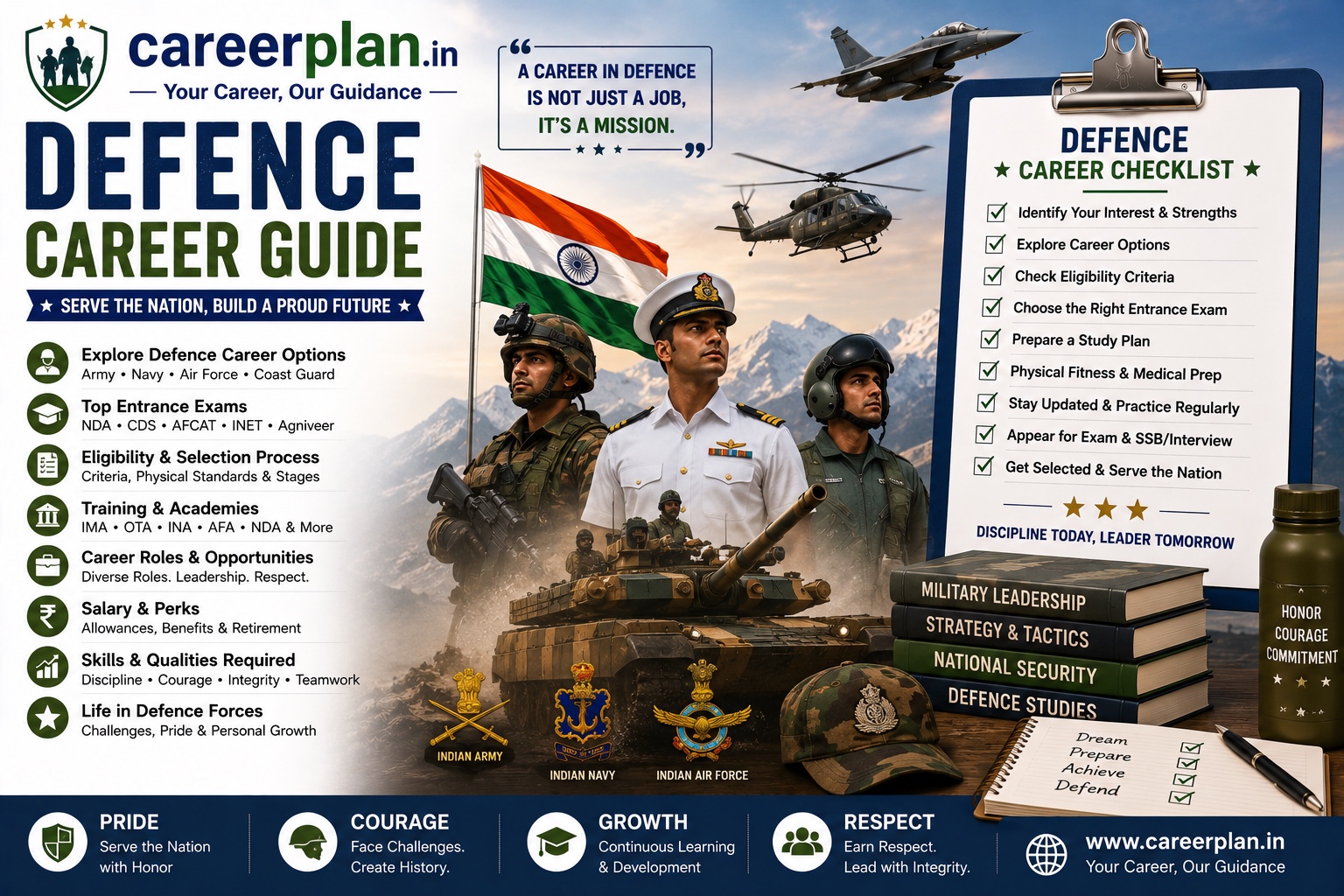
All Defence career guides
What is the Defence Field?
The defence field in India broadly covers two categories: military service under the three armed forces (Indian Army, Indian Navy, Indian Air Force) and civil aviation (commercial piloting), which shares significant overlap in terms of aptitude, medical standards, and entry pathways.
Within military service, there are two main tiers of entry for civilians: officer-level entry (commissioned officers, starting at Lieutenant or equivalent) and other-ranks entry (Soldiers, Sailors, Airmen). This hub focuses primarily on officer-level entry, which is the route most students planning after Class 12 or graduation are targeting.
Work in this field ranges from combat and operations to technical branches, logistics, education, legal, and administration within the forces. Commercial pilots, while not part of the armed forces, follow a parallel training and licensing path and are grouped here because NDA and AFCAT flying-branch aspirants often consider both routes together.
- Indian Army: Ground warfare, engineering, signals, ordnance, medical, legal, education branches among others.
- Indian Navy: Executive (including submarine and aviation), engineering, electrical, education, and naval architecture branches.
- Indian Air Force: Flying branch, technical branch, ground duty branches (administration, accounts, logistics, education, meteorology).
- Commercial Aviation: Airline pilots licensed by the Directorate General of Civil Aviation (DGCA), operating with Indian and international carriers.
Branches and Options Within Defence
The table below summarises the four main entry options covered on this portal. Each has a dedicated guide — this table helps you compare at a glance.
| Option | Eligibility | Entry Route | What It Leads To |
|---|---|---|---|
| NDA – National Defence Academy | Class 12 passed or appearing; Male (and Female from 2022 onwards for select entries); Age 16.5–19.5 years | UPSC NDA & NA Examination; SSB interview; medical | Commissioned officer in Army, Navy or Air Force after 3-year NDA + 1-year service academy training |
| CDS – Combined Defence Services | Graduate (degree specific to service branch); Age 19–25 years (varies by branch) | UPSC CDS Examination; SSB interview; medical | Commissioned officer in Army (IMA/OTA), Navy (INA), or Air Force (AFA) after respective pre-commission training |
| AFCAT – Air Force Common Admission Test | Graduate with specified subjects; Age 20–26 years (flying); 20–26 years (ground duty) | AFCAT exam conducted by IAF; AFSB interview; medical | Short Service Commission or Permanent Commission in IAF — Flying Branch or Ground Duty branches |
| Commercial Pilot / Aviation (CPL) | Class 12 with Physics and Mathematics; Age 17+ for Student Pilot Licence | DGCA-approved flying training; CPL licence exams; type rating | First Officer and eventually Captain at Indian or international airlines |
Is This Field a Good Fit for You?
Who tends to do well here
- Students with strong physical fitness and willingness to maintain it throughout their career.
- Those comfortable with hierarchical structures, discipline, and following orders as well as giving them.
- People who can handle long separations from family and posting to remote or challenging locations.
- Students with good spatial reasoning, decision-making under pressure, and leadership orientation.
- Those interested in aviation who have aptitude in Physics and Mathematics and pass stringent medical standards.
Who tends to find this field difficult
- Students who want full control over where they live and work — postings are determined by the organisation, not the individual.
- Those who prefer an 8-hour, fixed-routine work life. Operational requirements do not follow fixed hours.
- Anyone who cannot meet the medical and physical fitness standards set by the respective services — these are non-negotiable and cannot be appealed beyond the designated medical boards.
- Students looking for early financial independence who cannot sustain 2–4 years of competitive preparation with uncertain outcomes.
- Those who prefer rapid job-switching or portfolio careers — service careers involve long-term commitment and specific exit terms.
It is also worth noting: Arts stream students can join the Army through routes like the NDA (non-technical branches) and OTA via CDS, so stream choice after Class 10 is not always a barrier, though Science with Physics and Mathematics opens more branches.
How to Enter the Defence Field After Class 10 or 12
Your Class 10 stream choice affects which branches you are eligible for, but it does not close all doors. Here is a structured view:
After Class 10
- If you are targeting the NDA, CDS Flying branch, AFCAT Flying, or Commercial Pilot route, choose Science with Physics and Mathematics in Class 11–12. These are compulsory for flying-related branches and technically preferred for Navy and Air Force ground-duty entries.
- If you are targeting Army officer roles only (non-technical), you may take Science, Commerce, or Arts — the NDA and OTA (via CDS) accept Class 12 from any stream for Army entry.
After Class 12
- NDA route: Appear for the UPSC NDA & NA exam while in Class 12 or immediately after. This is the earliest officer-entry point.
- Degree first, then CDS or AFCAT: Complete a graduation degree and then appear for UPSC CDS or IAF AFCAT. Specific degree requirements apply per branch.
- Commercial Pilot: After Class 12 with Physics and Maths, enrol at a DGCA-approved flying training organisation (FTO). Obtain a Student Pilot Licence, then a Private Pilot Licence, and finally a Commercial Pilot Licence (CPL).
Broad entry structure
- Clear the written entrance exam (UPSC/IAF/DGCA path).
- Clear the Services Selection Board (SSB) interview (for all armed forces officer entries) — a 5-day psychological and group assessment.
- Clear the medical examination to the standards of the respective service.
- Complete pre-commission training at the designated academy.
Major Entrance Exams for Defence Careers
| Exam | Conducting Body | Frequency | What It Admits To |
|---|---|---|---|
| NDA & NA Examination | Union Public Service Commission (UPSC) | Twice a year | National Defence Academy (Army, Navy, Air Force wings); Naval Academy |
| CDS – Combined Defence Services Examination | Union Public Service Commission (UPSC) | Twice a year | IMA (Army), INA (Navy), AFA (Air Force), OTA (Army Short Service) |
| AFCAT – Air Force Common Admission Test | Indian Air Force (IAF) | Twice a year | Flying Branch and Ground Duty branches of IAF (Short Service and Permanent Commission) |
| DGCA CPL Licence Examinations | Directorate General of Civil Aviation (DGCA) | Multiple sessions per year | Commercial Pilot Licence — required to work as a co-pilot or captain at airlines |
| SSB Interview | Services Selection Board (Army/Navy/Air Force) | After written exam qualification | Mandatory psychological and leadership assessment for all armed forces officer entries |
Note: Some specific entries such as TES (Technical Entry Scheme for Army) and various Navy officer schemes have their own separate notifications. Check official service websites and the DGE (Directorate General of Employment) resources for current notifications.
Where to Study
Armed Forces Officer Training (post-selection)
Training for commissioned officers happens at government-run academies after you clear the exam and SSB. You do not choose these; they are assigned based on the service and entry scheme. Examples include the National Defence Academy (Khadakwasla), Indian Military Academy (Dehradun), Naval Academy (Ezhimala), and Air Force Academy (Dundigal). Training is fully funded by the government and candidates receive a stipend.
For graduation before CDS/AFCAT
- Central universities and state universities offering relevant degree programmes (Engineering, BSc, BA) are acceptable for CDS and AFCAT eligibility.
- There is no requirement to attend a specific category of institution for CDS/AFCAT eligibility — the degree subject and percentage matter more than the institution’s rank.
- NDA entrants do their graduation as part of the NDA/academy training itself, so a separate undergraduate degree is not needed before NDA entry.
For Commercial Pilot Licence (CPL)
- Training must be at a DGCA-approved Flying Training Organisation (FTO). Approved schools exist both in India and abroad (many students train in USA, Canada, Philippines, or South Africa due to cost and availability of flying hours).
- Check the current DGCA list of approved FTOs before enrolment. Approval status can change.
- Costs at Indian FTOs versus overseas FTOs vary significantly — research thoroughly before committing.
Coaching and preparation
Numerous private coaching institutes across India offer NDA, CDS, and AFCAT preparation. These are unregulated; assess them on track record, faculty credentials, and SSB mock-interview facilities rather than advertising claims.
Career Scope and Salary Overview
Compensation and career progression vary significantly by entry scheme, service, and years of service. The figures below are indicative ranges based on publicly available pay commission data and should be verified against current government notifications. Actual take-home pay includes allowances (Military Service Pay, flying allowance, ration, accommodation) which can be substantial but vary by posting.
| Stage / Role | Approximate Gross (INR) | Notes |
|---|---|---|
| Officer Cadet / Trainee (academy) | Stipend only (~Rs 56,000/month indicative) | Not a salary; varies by service and entry |
| Lieutenant / Flying Officer / Sub-Lieutenant (entry level) | Rs 8–12 LPA (basic + MSP + allowances) | Varies by posting, service, and allowances drawn |
| Captain / Flight Lieutenant / Lieutenant (5–8 years) | Rs 12–18 LPA | Flying allowance adds significantly for pilots |
| Major / Squadron Leader / Lieutenant Commander (8–15 years) | Rs 15–22 LPA | Range varies by service and specialisation |
| Colonel / Group Captain / Captain (senior) | Rs 22–35 LPA+ | Very few reach this level; competitive promotion |
| Commercial Pilot – First Officer (entry, domestic airline) | Rs 10–20 LPA | Highly variable; depends on airline, aircraft type, hours flown |
| Commercial Pilot – Captain (domestic airline) | Rs 35–80 LPA+ | Wide range; international routes and aircraft type affect this significantly |
All figures vary by employer, city, rank, years of service, and current government pay commission revisions. Do not treat these as guaranteed figures.
The Realistic Side of a Defence Career
This section covers trade-offs that are often understated in career guidance material. Read this carefully before committing.
- Competition is high: The NDA exam sees hundreds of thousands of applicants for a few hundred seats per cycle. SSB pass rates are low. Multiple attempts over several years are common before selection.
- Medical standards are strict and non-negotiable: Vision requirements, physical measurements, and health conditions are assessed rigorously. Many otherwise strong candidates are rejected at the medical stage. Get a preliminary medical check before investing heavily in preparation.
- CPL costs are very high: Commercial pilot training in India typically costs Rs 30–60 lakh or more. There is no assured job at the end — airlines hire based on vacancies, aircraft fleet sizes, and market conditions. The aviation sector has seen significant downturns (including airline shutdowns) that left pilots unemployed.
- Service conditions involve sacrifice: Postings to remote areas, border regions, or sea deployments are part of the job, not exceptions. Personal and family plans must accommodate this.
- Promotion is competitive and not guaranteed: Unlike many government jobs where time-bound promotions are the norm, armed forces promotions beyond a point are selective. A significant proportion of officers retire at the rank of Colonel or below (Army).
- Exit options mid-career are limited: Short Service Commission officers serve 10–14 years and then exit. Transitioning to civilian careers requires deliberate planning, and not all military skills translate directly to corporate roles.
- Preparation time is significant: Students who start NDA prep seriously in Class 11 or earlier tend to do better. Last-minute preparation rarely works for SSB, which tests personality and leadership built over years, not months.
How to Choose the Right Path in Defence
Use the questions below to narrow down which option suits you best, then read the individual career guide for that option.
Question 1: What age are you and what is your current qualification?
If you are in Class 11 or 12 right now, NDA is your earliest officer-entry option. If you have or are completing a degree, CDS or AFCAT are your primary routes. Commercial Pilot training can begin after Class 12 if you have the financial resources.
Question 2: Which service interests you most?
If you want to fly in a military setting, NDA (Air Force wing) or AFCAT (Flying Branch) are the relevant routes. If operational naval roles interest you, target NDA (Naval wing) or CDS (INA). If you are interested in the Army and are from any stream, NDA or CDS (IMA/OTA) apply. If commercial aviation is the goal regardless of military service, pursue the CPL/DGCA route.
Question 3: Can you meet the medical requirements?
Before committing to preparation, especially for the flying branches or CPL, consult a doctor about your vision, colour vision, and any existing health conditions. The individual career guides list specific medical standards for each option.
Question 4: What is your financial situation for CPL?
Commercial pilot training is privately funded and expensive. If financing is a concern, armed forces flying (NDA Air Force wing or AFCAT Flying) provides government-funded training — but selection is far more competitive and the career structure is military, not civilian.
Read the individual guide for your shortlisted option to understand the full exam pattern, SSB process, training details, and career progression before making your decision.
Frequently Asked Questions
NDA allows you to enter as a commissioned officer at 19–20 after Class 12, which means you start your career earlier. CDS requires a degree first but gives you the option to apply to all three services and IMA, INA, or AFA based on your preference. If you are confident about the defence career direction and meet the age and fitness criteria, NDA is generally the earlier and often preferred route. However, completing a degree first gives you a fallback qualification if you are not selected.
Yes. The Army (not the Air Force or Navy flying branches) accepts candidates from any Class 12 stream for the NDA Army wing and for CDS OTA (Officers Training Academy). The subjects Physics and Mathematics are not mandatory for Army officer entry. However, Science with Physics and Maths is required for Air Force and Navy entries and for the Commercial Pilot route.
The Services Selection Board (SSB) is a five-day selection process used by all three armed forces to assess officer-like qualities — intelligence, personality, leadership, and teamwork — through psychological tests, group tasks, and personal interviews. Clearing the written exam gets you called for SSB, but SSB selection rates are low, often under 20–25% of those attending. It cannot be prepared for by rote study; the assessment looks at traits developed over years. Many candidates attend SSB multiple times before clearing it.
UPSC does not impose a fixed limit on the number of attempts for NDA or CDS, but the age window limits how many times you can realistically appear. For NDA, you must be between 16.5 and 19.5 years, so most candidates get two to four attempts. For CDS, the upper age limit varies by entry (19–25 years for most branches), giving graduates roughly two to six attempts depending on when they start.
No. Commercial pilots are civilian professionals licensed by the DGCA and employed by commercial airlines. They are not part of the Indian Army, Navy, or Air Force. The route is included in this field hub because it is closely related in terms of aptitude requirements and because many students interested in IAF flying also consider the commercial route as an alternative.
Short Service Commission (SSC) officers serve for an initial period of 10 years, extendable up to 14 years in most cases. On completion, they exit the service with a gratuity and in some cases a pension, depending on the scheme. Some are offered Permanent Commission based on vacancies and performance. After exit, many move to sectors such as logistics, security consulting, aviation, corporate training, or government civilian roles, though this transition requires deliberate career planning.
Women can be commissioned into the Indian Air Force through AFCAT in Ground Duty branches (Administration, Accounts, Logistics, Education, Meteorology) and as of recent policy changes, also in the Flying Branch on Short Service Commission. For the latest position on women's entry across services, check the official IAF recruitment notifications, as policies have evolved and may continue to change.
Officers who serve a full career under the Permanent Commission generally receive a pension after retirement. Short Service Commission officers who serve 10–14 years receive a gratuity but the pension entitlement depends on the specific scheme under which they serve. Pension rules for defence personnel are governed by the Ministry of Defence and have been subject to revision, so candidates should check current rules before making assumptions about post-retirement benefits.